Als je vertaalfouten ziet, kun je ons hierover schrijven op het forum.
Sociometrische indices
Er zijn twee soorten sociometrische indices:- persoonlijke sociometrische indices;
- groepsindices.
De eerste kenmerken de individuele sociaal-psychologische eigenschappen van een persoon als groepslid. De tweede geven numerieke kenmerken van de volledige sociometrische configuratie van keuzes binnen een groep. Ze beschrijven de eigenschappen van communicatiestructuren in de groep.
1. Persoonlijke sociometrische indices
De belangrijkste persoonlijke sociometrische indices zijn:
- de sociometrische-statusindex van lid i;
- de emotionele-expansiviteitsindex van lid j;
- de index van omvang, intensiteit en concentratie van de interactie van lid ij.
De symbolen i en j verwijzen naar hetzelfde groepslid, maar in verschillende rollen:
- i — het object van de keuze;
- j — het subject van de keuze;
- ij — de combinatie van beide rollen.
1.1. Sociometrische-statusindex van groepslid i
Sociometrische status is de eigenschap van een persoon om als element van de sociometrische structuur daarin een bepaalde ruimtelijke positie (locus) in te nemen, oftewel zich op een bepaalde manier tot andere elementen te verhouden. Deze eigenschap is ongelijk ontwikkeld bij de elementen van de groepsstructuur en kan voor vergelijkingsdoeleinden worden uitgedrukt in een getal: de sociometrische-statusindex. De elementen van de sociometrische structuur zijn personen, de leden van de groep. Ieder van hen communiceert en wisselt in meer of mindere mate rechtstreeks informatie uit met anderen. Tegelijkertijd beïnvloedt ieder groepslid als deel van het geheel door zijn of haar gedrag de eigenschappen van de groep. Deze invloed verloopt via verschillende sociaal-psychologische vormen van wederzijdse beïnvloeding. De waarde van de sociometrische status benadrukt de subjectieve mate van deze invloed. Een persoon kan anderen positief of negatief beïnvloeden; daarom wordt gesproken van een positieve en een negatieve status. De status meet ook iemands potentiële leiderschapsvermogen. Voor de berekening worden de gegevens uit de sociomatrix gebruikt.
De sociometrische-statusindex van groepslid i wordt bepaald met de formule:
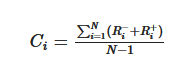
waarbij Ci de sociometrische status van lid i is, Ri de door lid i ontvangen keuzes zijn, ∑ het teken voor de algebraïsche som van het aantal ontvangen keuzes is en N het aantal groepsleden is.
In kleine groepen (N) kunnen Ci+ — de positieve status — en Ci– — de negatieve status — worden berekend.
1.2. Emotionele-expansiviteitsindex van groepslid j
De emotionele-expansiviteitsindex van groepslid j wordt berekend met de formule:
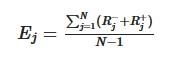
waarbij Ej de emotionele expansiviteit van lid j is en R de door lid j gemaakte keuzes (+, –) zijn.
Psychologisch gezien kenmerkt de expansiviteitswaarde de behoefte van een persoon aan communicatie.
2. Sociometrische groepsindices
De belangrijkste sociometrische groepsindices zijn:
- de emotionele-expansiviteitsindex van de groep;
- de index van psychologische wederkerigheid in de groep (groepscohesie).
2.1/ Emotionele-expansiviteitsindex van de groep
De emotionele-expansiviteitsindex van de groep wordt berekend met de formule:
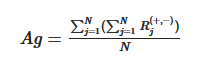
waarbij Ag de expansiviteit van de groep is en N het aantal groepsleden.
De index toont de gemiddelde activiteit van de groep bij het uitvoeren van de sociometrische test (per groepslid). De formule maakt duidelijk hoe actief de groepsleden bij het interactieproces betrokken zijn.
Interpretatie van de emotionele-expansiviteitsindex van de groep
Ag toont het gemiddelde aantal keuzes dat één groepslid heeft gemaakt.
- Ag = 0 — de deelnemers hebben geen enkele keuze gemaakt.
- Ag = 1 — gemiddeld heeft iedere deelnemer één keuze gemaakt.
- Ag = 2 — gemiddeld heeft iedere deelnemer twee keuzes gemaakt, enzovoort.
Hoe hoger Ag, hoe meer keuzes de deelnemers gemiddeld maken. Bij de interpretatie moet rekening worden gehouden met de onderzoeksomstandigheden en een eventuele beperking van het aantal keuzes. Een hoge of lage Ag-waarde is op zichzelf geen beoordeling van de kwaliteit van de relaties of de groepscohesie.
2.2/ Index van psychologische wederkerigheid in de groep
De index van psychologische wederkerigheid (‘groepscohesie’) wordt berekend met de formule:
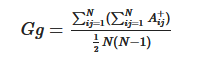
waarbij Gg de wederkerigheid in de groep op basis van positieve keuzes is, Aij+ het aantal positieve wederzijdse relaties in de groep en N het aantal groepsleden.
De cohesie-index toont het aandeel paarsgewijze wederzijdse relaties in de groep ten opzichte van het theoretisch mogelijke aantal van zulke relaties.
Interpretatie van de index van psychologische wederkerigheid (dichtheid van wederzijdse positieve relaties)
Gg heeft een waarde van 0 tot 1 en toont welk deel van alle theoretisch mogelijke paarsgewijze relaties in de groep uit wederzijdse positieve relaties bestaat.
- Gg = 0 — voor het onderzochte criterium zijn geen wederzijdse positieve relaties vastgesteld.
- Hoe hoger Gg, hoe groter de dichtheid van wederzijdse positieve relaties in de groep.
- Gg = 1 — het theoretische maximum: iedere deelnemer heeft een wederzijdse positieve relatie met iedere andere deelnemer.
De Gg-waarde moet samen met de structuur van het sociogram en andere sociometrische indicatoren worden geïnterpreteerd. Een lage absolute indexwaarde betekent op zichzelf niet dat interactie of steun tussen deelnemers ontbreekt.
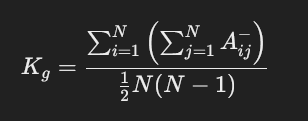
2.3/ Conflictindex
De conflictindex kenmerkt het conflictpotentieel van de groep. De index is symmetrisch aan de index van psychologische wederkerigheid en vormt een index van negatieve wederkerigheid: hij wijst op de aanwezigheid en mate van wederzijds negatieve paren. Zulke paren verminderen de consolidatie van de structuur en het vermogen van de groep om haar evenwicht te bewaren.
Interpretatie van de conflictindex
Kg toont het aandeel wederzijdse negatieve relaties ten opzichte van het theoretisch mogelijke aantal paarsgewijze relaties in de groep.
- Kg = 0 — voor het onderzochte criterium zijn geen wederzijdse negatieve relaties vastgesteld.
- Hoe hoger Kg, hoe groter de dichtheid van wederzijdse negatieve relaties in de groep.
- Kg = 1 — het theoretische maximum van wederzijdse negatieve relaties.
De index beschrijft de structuur van wederzijdse negatieve keuzes, maar maakt op zichzelf geen conclusie mogelijk over de aan- of afwezigheid van werkelijke interpersoonlijke conflicten. De index moet samen met het sociogram en andere indicatoren worden beschouwd.
2.4/ Groepsreferentie-index (groepstevredenheid)
Hoe hoger de referentie-index, hoe hechter de relaties tussen de elementen van de groepskern waarvan het gedrag bepalend is voor het ontwikkelen van een gemeenschapsgevoel. De index toont in hoeverre groepsleden tevreden zijn met hun voorkeuren. Als U dicht bij 1 ligt, is aan de meeste voorkeuren van de deelnemers voldaan. Als U kleiner is dan 1, is een deel van de voorkeuren niet beantwoord.
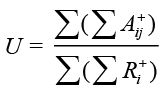
waarbij  de som van de wederzijdse positieve keuzes in de groep is;
 de som van de positieve keuzes in de groep is.
Interpretatie van de groepsreferentie-index (groepstevredenheid)
U toont het aandeel positieve keuzes dat door een wederzijdse positieve keuze wordt beantwoord.
- U = 0 — geen van de positieve keuzes is wederzijds.
- U = 0,5 — de helft van de meegerekende positieve keuzes houdt verband met wederkerigheid.
- U = 1 — alle meegerekende positieve keuzes zijn wederzijds.
Hoe hoger U, hoe groter de wederkerigheid van de positieve voorkeuren van de groepsleden.
2.5/ Wederkerigheidsindex van negatieve keuzes
Toont het aandeel negatieve keuzes met een wederzijdse negatieve keuze. Anders dan bij Kg is de noemer het werkelijke aantal negatieve keuzes.
R− = 2M− / L−
M− is het aantal wederzijds negatieve paren; L− is het totale aantal gerichte negatieve keuzes. Elk wederzijds paar wordt eenmaal geteld en bevat twee keuzes.
0 — geen negatieve keuzes zijn wederzijds; 0,5 — de helft is wederzijds; 1 — alle negatieve keuzes zijn wederzijds.
De index wordt niet berekend als er geen negatieve keuzes zijn. Bijvoorbeeld: 10 negatieve keuzes en 2 wederzijds negatieve paren geven R− = 2 × 2 / 10 = 0,4. De index beschrijft wederkerigheid voor het onderzochte criterium en duidt op zichzelf niet op werkelijke conflicten.